
Why the Bulls Will Win 2019


This article was originally published on this site
Naysayers in the financial media are working overtime this week to show why we should all fear the dreaded inverted yield curve.
These talking heads are convinced this inversion surely foretells the end of the bull market.
BUT…
Don’t listen to a word of it. Nothing could be further from the truth.
To Quickly Recap…
Last month, the spread between 10-year Treasury yields and the interest rate on 3-month T-bills went negative for the first time in more than 10 years.
I diligently alerted you to this in a previous Wealth Watch, and gave some important caveats to the doom and gloom the financial media were spewing.

Yes, it’s true the last yield curve inversion happened in 2006, not long before the housing bust and 2008 financial crisis.
And as the lamestream media keep searching for dark clouds rather than silver linings, they are beating this correlation to death.
But here’s the truth.
Why the Best Is Yet to Come for Stocks
Stocks very often post their best gains AFTER a yield curve inversion. The chart below highlights this trend perfectly.
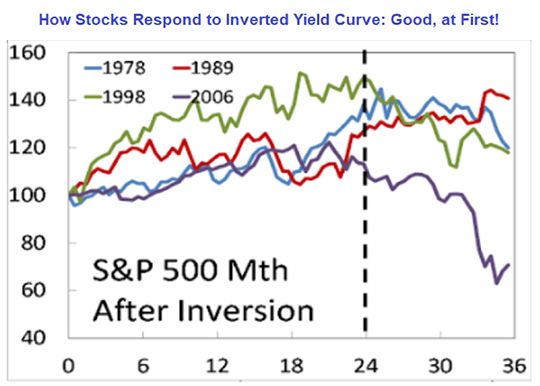
Pulled from a recent JPMorgan research note, the chart clearly shows robust gains for at least 24 months after a yield curve inversion.
That’s the real silver lining to this story.
And in JP’s note, analysts write: “Performance of the stock market after the onset of inversion tends to be extraordinarily strong… The pace of market gains tends to be above average for up to about 30 months after first inversion.”
Meaning while inversions often eventually do lead to an economic recession, there’s often a very big lag time — up to 30 months before it actually happens!
And most of that time stocks enjoy very big melt-up gains.
The median gain for the S&P 500 after the yield curve inverts is over 10%.
But historically there are plenty of examples of much bigger returns before markets roll over. Here are a few:
- In 1978 the yield curve inverted in October and the S&P gained nearly 50% over the next two years
- And in 1998 the yield curve went negative in September, and — get this — the Nasdaq soared 226.9% over the next 1½ years, while the S&P surged nearly 50% higher!
- Even after the most recent inversion in 2006, the S&P rallied 20% higher over the next two years.
That’s why it’s no surprise to me that the Dow rumbled 329 points higher this Monday and has kept moving higher all week.
This market is just getting warmed up for much bigger gains to come.
Don’t let fear-mongering about an inverted yield curve throw you off this raging bull market yet.
Now more than ever you should stay invested in stocks, racking up as much profit as you can over the next year or two.
That way when the market does indeed finally roll over, you’ll be all the better prepared.
Here’s to growing your wealth.
Mike Burnick
Chief Income Expert, Mike Burnick’s Wealth Watch